A Case for Christian Education
3 points of consideration for families as to why a Christian school might be the right fit for their high school students.
Don’t have time to read it now? Download now, read later:
Is a Christian high school the right fit for my student? As parents seek to answer this question, we invite you to consider three things:
-
there's no such thing as a truly neutral education;
-
faith that's kept separate from daily life tends to stay separate;
-
and even strong Christian kids need real training before they can be a witness to others.
We aren't presenting these as a moral mandate; instead, we offer them as a starting point for your family's own conversation about what kind of education will help your student's faith take root and grow.
By the time a student graduates from high school, he or she will have spent roughly 2340 days at school. That’s roughly a third of their life before graduation. High school students typically spend 40-50% of their waking hours on any given school day at school.
Put simply, student's worldview (philosophy or conception of life) will be affected by the people and culture that they are exposed to for that amount of time. In this guide, we discuss why we believe a Christian education option is worth serious consideration for Christian families.
As Christian parents put effort into helping their children grow in "fear and admonition of the Lord," a Christian school can help with that effort. Deuteronomy 6:4-9 says: “Love the Lord your God with all your heart and with all your soul and with all your strength. These commandments that I give you today are to be on your hearts. Impress them on your children. Talk about them when you sit at home and when you walk along the road, when you lie down and when you get up. Tie them as symbols on your hands and bind them on your foreheads. Write them on the door frames of your houses and on your gates.”
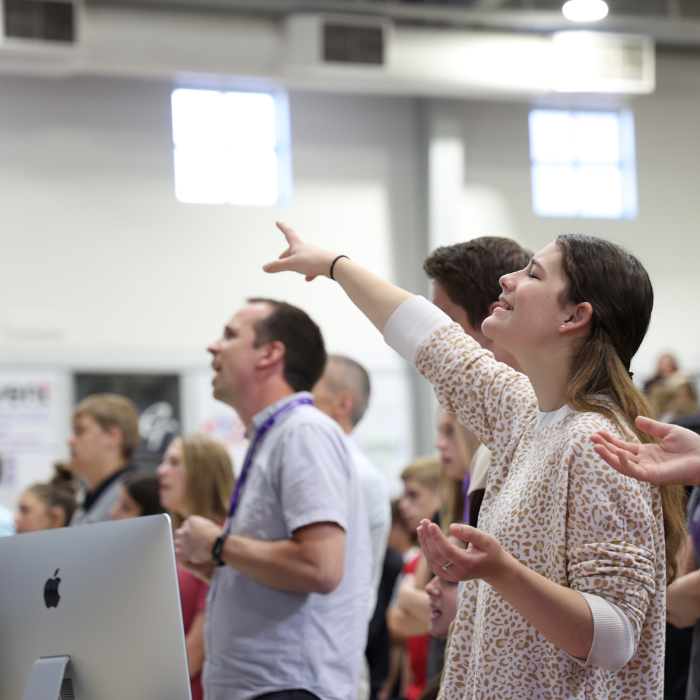
A Christian school can help train students in just this way – through the daily rhythms of worship, like chapel, that reinforce what's being taught at home.
The following is not a moral mandate for Christians to get their kids in Christian schools or escape from public schools, although we certainly respect discerning Christians who view it as such. But we do believe that discerning Christian families should be clear about what each educational choice brings to the table. Here are three statements for consideration:
Table of Contents
The Misconception: "Public School Is a Neutral Choice"
Table of Contents
There is no such thing as a neutral worldview. Every school — public, private, or Christian — teaches students some worldview, whether or not it says so out loud. The question isn't whether your student's school will shape their beliefs; it's which beliefs it will shape them toward.
Stated another way: “In the absence of religion, one is inevitably left with...religion.”
When you think of public schools as similar to “public libraries,” “public parks,” or “public forums,” it’s natural to trust that public schools are neutral places where a student’s Christian worldview and beliefs will be honored and respected. In some ways, it’s natural for people to view public schools as neutral educational environments as it relates to worldview.
Yet, without diving into a major history lesson here on the historical origins of public school philosophy, it’s evident to most that being a government entity in today’s world means avoidance of anything “Christian.” As Christians, this should come as no surprise.
Christianity has no middle ground: either Jesus rose from the dead that Easter morning or he didn’t. Jesus Himself was not neutral.
The messages from any worldview that does not acknowledge Jesus as a risen Savior run the risk of being in conflict with Biblical teachings. In Matthew 12:30, Jesus says: “Whoever is not with me is against me, & whoever does not gather with me scatters.”
Consider for a second the messages that often come from a non-Christian or secular worldview culture. Some are obvious, and some are subtle:
- Humans evolved from monkeys (obvious)
- Evolution is a viable worldview (subtle)
- Absolute truth does not exist (obvious)
- People are by nature “good” (subtle)
- You are the most important person (subtle)
- Answers can be found within oneself (subtle)
- No one really has faults and weaknesses (subtle)
Here’s a story from Rev Jonathan Fisk that emphasizes the point:
“Here’s an example that should hit all angles: There was a time when I was playing an old video game to entertain my kids (you know, educating them!) My oldest three were attending local public school at the time. I got stuck on the third level, and couldn’t get past the boss.
I kid you not: for two hours, I died. Over and over again. Until, finally, I yelled at the TV, “Man, I’m terrible at this!” But then my ten-year-old cut me off and said, “No, Father! Never tell yourself that you are bad at anything!” Immediately, I thought, “Oh, no. I’ve lost her.”
That was the moment I decided I was taking my kids out of public school.
There will be a lot of well-meaning people who might not even see why. But for me, this was a far larger issue than the culture wars we talk about on the news. This was my child learning by osmosis to believe that it is immoral to acknowledge faults and weaknesses.
More, this wasn’t a matter of something she learned in a textbook. This was a core value of her human identity that the entire culture of the school was imparting to her, one which would stop her from learning how to grow through failures with resolve, and also, I believe, directly threatens the biblical teaching of acknowledging our original sinfulness with grace and trust in Christ.”
Anti-Christian worldview messages, even the subtle ones, are a powerful influence on kids. Environments and people that support and/or promote those messages may not be working in congruence with what is being taught at home and at church.
For Christian parents that choose a public or non-Christian education - know that the environment is not neutral.
This is so important since their cognitive development causes them to think independently. This sometimes means thinking critically of their parents or even questioning the way they have been brought up. All the more reason to have teachers, coaches and staff that can reinforce the Christian Worldview at school.”
Be prepared to spend the time each day undoing the secular worldview being taught to your students. It will require time, effort, and prayer for their hearts and minds to be guarded against the non-Christian messaging of their school environment.
A Truth: Non-Christian Schools Can Create Christians Who Compartmentalize Their Faith
Non-Christian schools can create Christians who compartmentalize their faith.
Even Christian students who know their faith well can learn, without realizing it, to keep it separate from the rest of their life. Over years in an environment where faith is treated as private and school is treated as "real life," students can absorb the habit of compartmentalizing — believing one thing on Sunday and living another way the rest of the week.
“The ultimate point of all education is not to accumulate facts and technique, but to become virtuous - that is to discover how the knowledge we acquire ought to be applied. This is the difference between knowledge and wisdom. We are called to be wise.” – Rob Dreher, Crunchy Cons
For the Christian family that works diligently to teach their kids to recognize the non-Christian worldview presented in school and measure it against Scripture, another more consistent danger may be present. That danger is that over the long term, kids are encouraged to separate their faith from a major portion of their life. Think of it this way:
“Because of the nature of public schools [versus private education], the least amount of damage that will be done to students is they will be taught to separate their faith life from their school life. What starts as “believe what you want but keep it to yourself” quickly grows into a habit of viewing faith life as separate from real life.” (Douglas Wilson, Excused Absence, 2001)
Or another way:
“When God is excluded from the classroom, we are not merely remaining silent about God. We are teaching children that they may safely disregard Him. Whether or not God exists, the lesson goes, His existence is irrelevant to what we are doing ‘here.’ So when God is omitted, we are not silent about Him; rather, we are teaching the children in the most convincing way possible that God is irrelevant. Children can then safely omit Him when it is convenient to do so.” (Douglas Wilson, Excused Absence, 2001)
On an anecdotal level, we often see this when students come to Lutheran High School after being in public schools.
Despite being 100% on board with what is being taught in class, oftentimes students struggle to speak it, put it into action, and live it simply because for so many years they have had to stay quiet about their faith.
(Incidentally, this is why we love students where Lutheran High School is their first Christian school experience. We get the privilege of watching them learn to express their faith in thought, word, and actions as God works faith in their hearts.)
Consider how different the missions of “believe what you want but keep it to yourself” and “training up spiritual champions to influence the world for Jesus” are.
The goal of Christian schools is to encourage students in their faith, encourage their growth, and prepare students to be lifelong Christians.
Faith is not something to be kept hidden only to come out at home or at church. Christian schools walk alongside families toward a common goal of preparing students to have a faith that endures and grows over their lifetime. Again from Wilson, 2001:
“The task of learning to think like a Christian in every area of life is a serious and demanding one, even when both parents and teachers understand this task and are committed to it. But if teachers are not committed to the task or are hostile to it, the task is impossible. If you want your children to learn to play the violin, do you apprentice them to a blacksmith? If you want them to master art, do you apprentice them to a football coach? If you want them to think like believers, do you apprentice them to unbelievers or silenced believers?”
We’d be remiss if we didn’t acknowledge that public schools do have Christian teachers, coaches, and employees that undoubtedly act as guides and mentors to Christian students in the public school environment.
We praise God for those men and women who take opportunities to do that even if and when it wouldn’t be “appropriate” for them to do so.
“But, the mere presence of some Christian teachers and administrators doesn’t mean that our children are receiving a Christian education.” (Bruce Shortt, 2004)
On Being Salt & Light
“You are the salt of the earth . . . You are the light of the world.” – Matthew 5:13-14
"I'm sending my kids to public school so they can be salt and light," is one of the most common reasons Christian parents give for staying in public education. It's a good instinct, but it assumes a level of spiritual readiness that most teenagers, even strong ones, haven't developed yet. Before a student can be a witness to others, they need to be equipped first.
It's good to want and expect our students to be witnesses for Christ. But it's also good to simply ask: Are they ready?
Rod Dreher in his book, The Benedict Option (2017) bluntly says: “Some tell themselves that their children need to remain there to be “salt and light” to the other kids. As popular culture continues its downward slide, however, this rationale begins to sound like a rationalization. It brings to mind a father who tosses his child into a whitewater river in hopes that she’ll save another drowning child.”
While the spiritual maturity of some adolescents can be real and powerful, parents should honestly assess the readiness of their children to be missionaries. Is it their passion? Do they know how to talk to non-Christians about Jesus? Do they want to? Can they defend Christianity in the open marketplace of ideas? Are they struggling with doubts of their own?
“The salt and light of the earth theology is laudable, but misapplied in education because children simply don’t have the experience to be evangelists for the Christian faith, given the onslaught of human secularism, political-correctness and the demand for conformity in the public schools. Confronting these is work for adults. Christian families should not be sending in children as surrogate evangelists before they are old enough to handle the pressures of the hostile environment.” (E. Ray Moore Jr, Exodus Mandate, 2002)
We find that high school students, even the ones who have been in Christian schools their whole life, often will wrestle with the big questions of life while in high school:
- Who am I?
- What is my purpose?
- Was Jesus who He claimed to be?
- Is Christianity rational?
- Is Jesus the only way to heaven?
We want them to wrestle with those questions in an environment that supports them in that search. (Note: This is one of the best things about Lutheran High School and the topic we explore in our guide, Encouraging Growth in Christ.)
The point is that an adolescent who is wrestling with those larger questions may not be the best candidate to actively evangelize non-Christians in a hostile environment. And in fact, they may miss out on the opportunity to receive the valuable training that a Christian school can provide.
“I was that kid. I went to Christian schools and a Lutheran high school but I didn’t want to be a Christian just because my parents were or because that is how I was raised. I desperately wanted to know that I wasn’t being taken in by some huge colossal propaganda program. I had doubts and to this day I praise God and thank my parents for making the commitment to a Christian high school education so that I could openly wrestle with those questions.
Those teachers taught me evidence for Christianity, how to defend it, apologetics, and such. They taught me about ‘worldview’ and encouraged me in my walk with God in an encouraging way that I am positive I would not have received at that level from any other avenue.” (Dan Gehrke, Executive Director at Lutheran High School)
In the midst of that training, God indeed provides opportunity to witness to others. Here is one example from this current school year at Lutheran High School:
We don’t have a girls lacrosse team but are blessed to be able to send our lacrosse players to the local public schools so they can participate on their teams. One of our Lady Lions spent four years playing on a local public school team, and by the end of the four years she had gained tremendous respect and love of her teammates. They knew there was something different about her and through that relationship she was able to be Christ to them.
Conclusion
Christian education is meant to prepare students to help shape the world and bring His Kingdom here, now – grounded in core values that prepare them for life beyond high school. LuHi's goal is to send out young men and women who graduate ready to be future-shapers: bold, grounded, and equipped to make a real Kingdom impact wherever they go next.
We provide a highly relational academic experience – the kind of environment worth weighing when considering the values that matter most in choosing a high school – centered around excellent teaching rooted in God’s Word.
Our desire is that this guide provides talking points for Christian families as they discuss and seek God’s guidance around school choice. Christian schools choose to focus on different areas of growth for their students. Some focus on the formation of their students. Others focus on the transformation of their students. The difference is subtle but present. At LuHi, we focus on foundation. We help students understand what it means to live lives rooted in Christ and how Christian community shapes authentic, lasting relationships.
To learn more about the mission, vision, and core values of Lutheran High School in Parker, CO, please visit www.lhsparker.org. To set up a personal tour of the school, please contact our Admissions Department at admissions@lhsparker.org or 303-841-5551.