
It's a strange time in the world of college admissions. The drop from high school grads enrolling in college dropped from 70% to 62% in 2022 and that trend has continued. Recently, the chancellor of Syracuse University announced it woudn't meet it's target enrollment for the first time in years. Colleges are seeing what's known as the enrollment cliff.
On the other hand, C2Education shares that colleges are seeing higher application volumes than ever in their Analyzing 2026 Trends webinar. This means that college admissions offices are adapting faster, more triage-oriented review processes. So, seniors applying to college have less time to make a higher impact.
What does this mean for LuHi students? Our Guidance Team is very well vesed in what factors matter most in the college decision process. Here are three tips from their office:
1) For the most accurate information, go straight to the source.
Let's say you're interested in Baylor University, CSU, and GCU. The best place to start to see what matters for each application is on their website. The admissions page of a college’s website will tell you the information most relevant to their decision. Each college is unique. You can also pick up the phone and call their admissions office if you prefer.
2) If an application says a component is optional, think of it as required.
Does the application say three recommendation letters are recommended? Or maybe it says submitting test scores is optional (more on test scores below). Plan on sending all three recommendations as well as your test scores. They wouldn't list it if it didn’t play a role in their decision.
3) Admissions reps want to see your character come through.
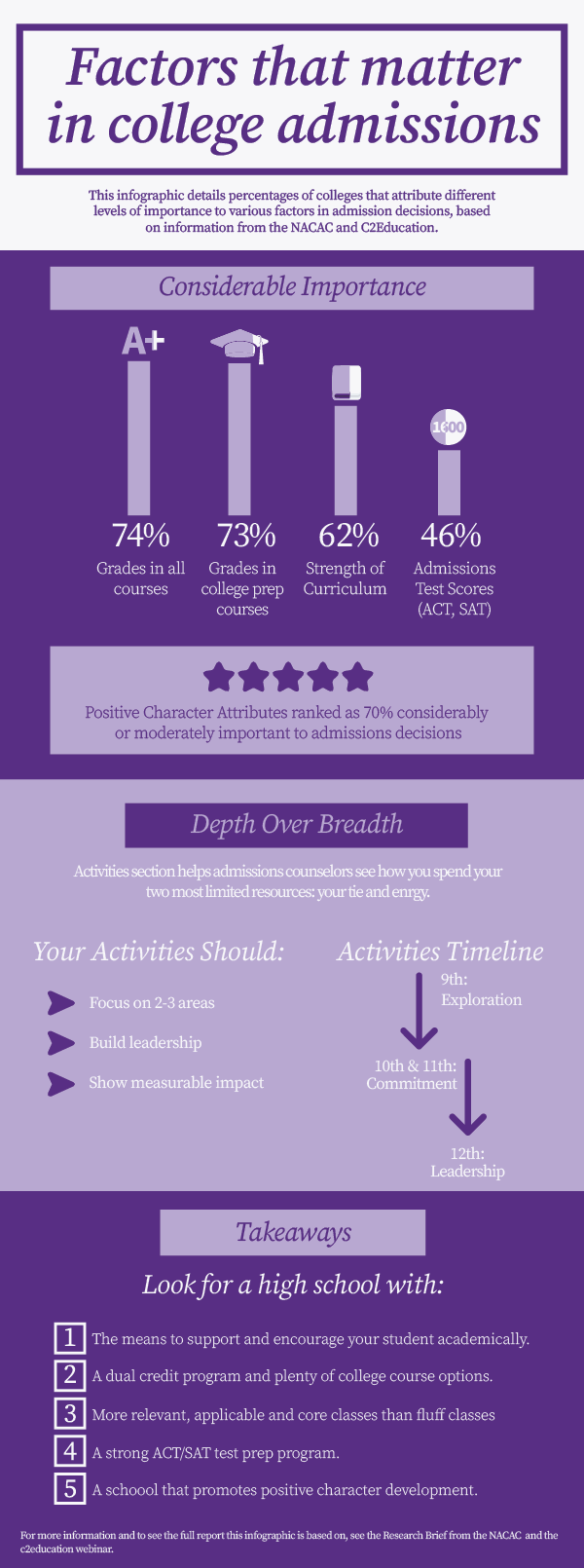
According to the National Association of College Admission Counselors (NACAC), 70% of admissions officers say that a student’s character attributes are either “considerably” or “moderately” important in the admissions process. Private universities rate character as more important than public universities.
There are three main ways to show your character:
- Your essay
- Your recommendation letters
- The nature of your extracurricular activities and work experience
If an admissions office conducts interviews, then that will also be a place for your character to shine through.
Some high schools, like LuHi, have started incorporating character development into their curriculum. Some schools have designated programs or courses. But most, like LuHi, build it into their current class offerings. Christian Decisions and Leadership are two examples of LuHi courses with character development incorporated. As a Christian school, our focus is on Christian Character Development.
Let’s talk test scores.
An article from C2education shares that test scores are making a comeback in college applications. "In the past two years, we’ve seen a marked increase in the number of colleges that seem to be riding the line between test optional and test required. These are schools that are officially test optional but that subtly indicate a preference for test scores."
See the infographic below for a breakdown of the most important factors in college admissions decisions. We also recommend these two articles for further reading:
Originally published in 2017, updated for accuracy in 2026.


.png)